

Momentum is Building to Close the Gender Health Gap

Over the past decade awareness of the gender health gap has gradually increased with political stakeholders beginning to take action to drive change, but there is still a long way to go before women’s health needs are fully met.
Women make up half the world’s population, yet their health remains persistently underfunded and underprioritised across many regions. Around 25% of women spend more of their lives in poor health when compared to men.1
This gender health gap is not solely a medical issue, it carries profound personal and socioeconomic consequences. Addressing the time that women spend in “poor health” not only will improve the health and lives of millions of women, but also could boost the global economy by at least US$1 trillion annually by 2040.2
Undiagnosed or mismanaged health conditions not only diminish women’s quality of life, but also reduce productivity and drive up healthcare costs. As women provide over 75% of both paid and unpaid care globally, any impact on their health creates a ripple effect throughout families, communities and healthcare systems.2
The Burden of Poor Health on Women
The burden on individual women impacts their life manifesting in a restricted ability to participate fully in daily life. Chronic conditions such as cardiovascular disease, autoimmune disorders, hormonal and reproductive health issues and mental health concerns account for over a third of women’s disease burden and are frequently misdiagnosed or dismissed.3 Addressing these conditions could add up to $400 billion to global GDP by 2040 and improve the quality of life for women worldwide.3
Nine health conditions account for 35% of women’s disease burden globally including:3
- Ischaemic heart disease
- Breast cancer
- Cervical cancer
- Endometriosis
- Menopause
- Maternal hypertensive disorder
- Premenstrual syndrome
- Migraine
- Post-partum haemorrhage
The challenges faced by women to access quality healthcare vary across the globe. In low- and middle-income countries, access is limited by poverty, cultural norms and social determinants of health. For example, 94% of the ~350 000 deaths caused by cervical cancer in 2022 occurred in these countries.4 This reflects inequalities in access to vaccination, screening and treatment services in these areas.
In developed countries, the burden often manifests as delays in care and inadequate workplace adjustments, leading to a diminished quality of life and reduced economic participation. For example, endometriosis takes on average 6.8 years to be diagnosed.5
Limited Progress
The Hologic Global Women’s Health Index has collected five years of data on women’s health. It represents the knowledge, attitudes and behaviours of women and girls aged 15+ and tracks progress in women’s health and well-being worldwide. The Index measures five dimensions of health: Preventive Care, Emotional Health, Opinions of Health and Safety, Basic Needs and Individual Health. When taken together, the dimensions explain about 70% of the variance in a woman’s life expectancy at birth.
Over the five years the Index, the average global score ranges from 53-54 highlighting limited global progress.6 Taiwan has consistently ranked first globally with the highest Index score (72) achieved in Year 3.6 The lowest score (22) was seen in Year 2 in Afghanistan. Austria, Germany and Switzerland have also consistently performed well, remaining in the top ten ranked countries over the five years with scores ranging from 64-67.6
The latest (Year 5) data identifies where progress has been made and where there is progress to be made. In positive news, more women than at any point in the Index’s history were tested for high blood pressure, diabetes and cancer. However, at the global level, screening rates remain unacceptably low. Women’s perceptions of their personal safety have also improved.6
On a less positive note, an estimated 1 billion women struggle to afford the basics and high levels of worry and sadness continue to negatively impact women’s emotional health.6 Women’s physical health also continues to suffer, with a third of women experiencing daily physical pain and nearly one in four reporting health problems serious enough to interfere with activities.6
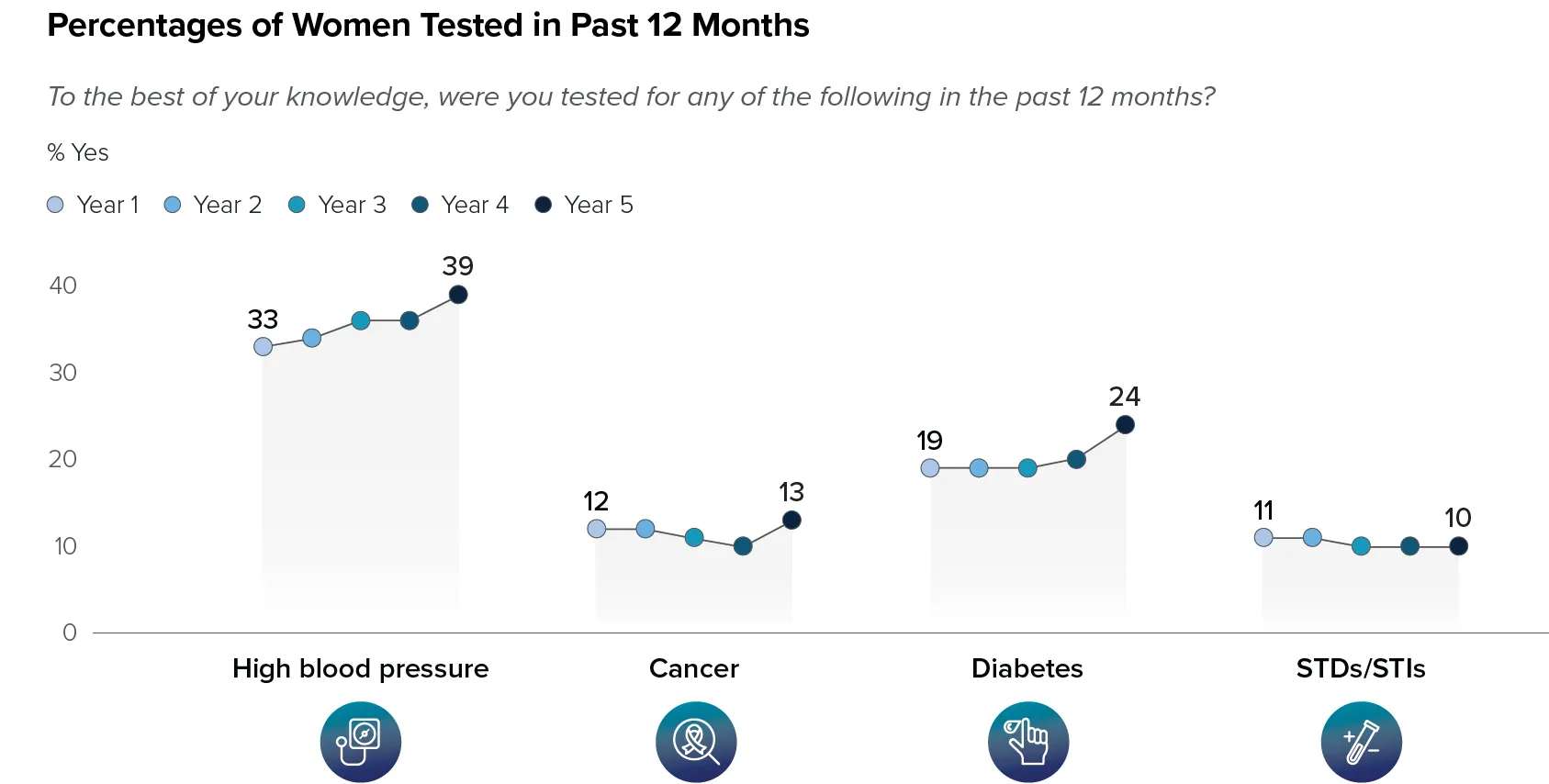
Figure: Preventive Data from the Hologic Global Women's Health Index
Driving Change
Steps are being taken across the globe as greater awareness of the need to address the women’s health gap is rising. However, achieving real change requires collaboration and a global commitment.
It will require the development and implementation of country-specific women’s health strategies establishing a lifelong roadmap for generational health and wellness. Progress has been made in Australia, Austria, Canada, England, Ireland, New Zealand and Wales, which have already published women’s health strategies or action plans. The European Commission also has specifically called out women’s health in its Gender Equality Strategy and women’s needs in its Safe Hearts plan.
More public and private investment in data-driven approaches that improve health outcomes for women across their lifespan is also needed. Additionally, research and development focusing on underfunded, under researched or poorly understood women’s health conditions needs to be accelerated.
These alone will not be enough. Barriers to accessing quality healthcare including screening and early detection for cancer and other conditions disproportionally affecting women need to be addressed. This includes tackling the root causes of poor health including gender inequity, poverty, health literacy and social stigma.
Ultimately, only genuine collaboration across all stakeholders will deliver meaningful action and change.
Explore more about the global disparities in the (In)Visible Inequities report
For more insight articles, visit the Hologic Innovation Exchange.
World Economic Forum. Blueprint to Close the Women’s Health Gap: How to Improve Lives and Economies for All. Insights report. January 2025. https://reports.weforum.org/docs/WEF_Blueprint_to_Close_the_Women%E2%80%99s_Health_Gap_2025.pdf
International Labour Organization. Care work and care jobs for the future of decent work. 2018. www.ilo.org/sites/default/files/wcmsp5/groups/public/%40dgreports/%40dcomm/%40publ/documents/publication/wcms_633135.pdf
McKinsey Health Institute. Closing the Women’s Health Gap. 17 January 2024 www.mckinsey.com/mhi/our-insights/closing-the-womens-health-gap-a-1-trillion-dollar-opportunity-to-improve-lives-and-economies
World Health Organization. Cervical Cancer. www.who.int/news-room/fact-sheets/detail/cervical-cancer. Last accessed 1 April 26
Fryer J, Mason-Jones AJ, Woodward, A. Understanding diagnostic delay for endometriosis: A scoping review using the social-ecological framework. Health Care for Women International, 2025;46(3):335–351
The Hologic Global Women’s Health Index. hologic.womenshealthindex.com/report-and-data. Last accessed 1 April 2026